9 Jun
10 Jun
11 Jun
12 Jun
13 Jun
14 Jun
15 Jun
16 Jun
17 Jun
18 Jun
19 Jun
20 Jun
21 Jun
Focusing on hunters and hunting, the brutal ending of a life, an act which sustains another’s. The hunt is by far the most dramatic event on the plains of the Serengeti. Part 3 of 12.
As the earth heats up, the land under our feet is compromised. A warmer earth can lead to a deadly domino effect: an increase in occurrence, frequency and intensity of sinkholes and landslides. More voluminous rainfall leads to massive mudslides and debris flows, wiping out entire communities. This episode tells the story of devastating events in California and British Columbia, Canada. Part 4 of 10.
Peter and Catherine the Great - these Tsars conquer parts of Northern Europe, the Crimea, and the Caucasian region by force. Their successors defend the empire against Napoleon and establish Russia among the great powers.
The Red Army, forged by Leo Trotsky from revolutionary guards and members of the Tsarist troops, becomes the sword of Communist Russia.
With Putin, the army regains its force and momentum. His wars in Georgia, Chechnya and Ukraine betray the cunning spirit of a secret service man, always ready to lay the blame on Western liberal states.
The Soviet Union was formed on 30 December 1922 after five years of civil war. Stalin’s iron fist and his Great Purge gave him unopposed murderous rule over the country, while heroically defeating Hitler’s onslaught on Kursk and Stalingrad between 1941-43 effectively won WWII for the allies, and helped mark out his geopolitical world and power until his death in 1953. Part 1 of 3.
With the pace of the 1950’s Cold War increasing, alongside the the space race and the Berlin Wall, the decision to join forces with Cuba and build missile sites there brings the world to the brink of disaster. While the Cuban Missile Crisis is averted and a peace settlement reached, not long after JFK is assassinated in 1963 by Lee Harvey Oswald, a US Marine veteran who had defected to the Soviet Union in 1959. Part 2 of 3.
With the escalation of nuclear missiles globally, Brezhnev invades Czechoslovakia in 1968, as the proxy East vs West war in Vietnam continues. Following the catastrophic invasion of Afghanistan in 1979, a new era begins with Mikhail Gorbachev, as his bold statements quickly lead to a withdrawal from Afghanistan, and by 1989, the collapse of communism. That same year the symbolic Berlin Wall falls, with the end of the Soviet Union formally declared in August 1991. Part 3 of 3.
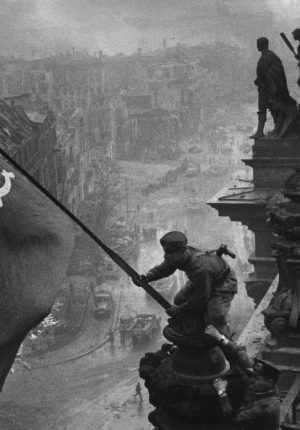
Created by Trotsky in 1918, the Red Army abandoned its egalitarian and democratic ideals to repress civil revolts. Stalin, worried about the power of the army, launched a purge of officers, the beginning of the 'Great Terror' of 1937-38. As a consequence, the Red Army was a shadow of its former self when Germany invaded the USSR in 1941 and it took all the energy of General Zhukov, the Resistance and the Allies to overcome the Nazis. On its way to Berlin, the Red Army discovered the extermination camps. Germany surrendered on May 2, 1945. Part 1 of 2.
After the Second World War, the soldiers of the Red Army fell into disgrace. As the Cold War began, Khrushchev rehabilitated the Army for purely repressive purposes, and revolts were suppressed in blood. Following the Cuban Missile Crisis, the USSR and the Capitalist Bloc jockeyed for position. Meanwhile, as Russia entered the 1970s the living conditions of the Red Army’s soldiers deteriorated. The long intervention in Afghanistan definitively undermined the Soviet system, and at the end of 1991 the USSR disappeared. Today, the Red Army is purely symbolic, caught between nostalgia and nationalism. Part 2 of 2.